Identify the cartridge, not just the turntable
Find the cartridge and stylus model actually fitted. A turntable may have been upgraded, and a replacement stylus can differ from the part originally supplied. Keep the model information with the turntable manual so that maintenance advice can be traced to the current assembly.
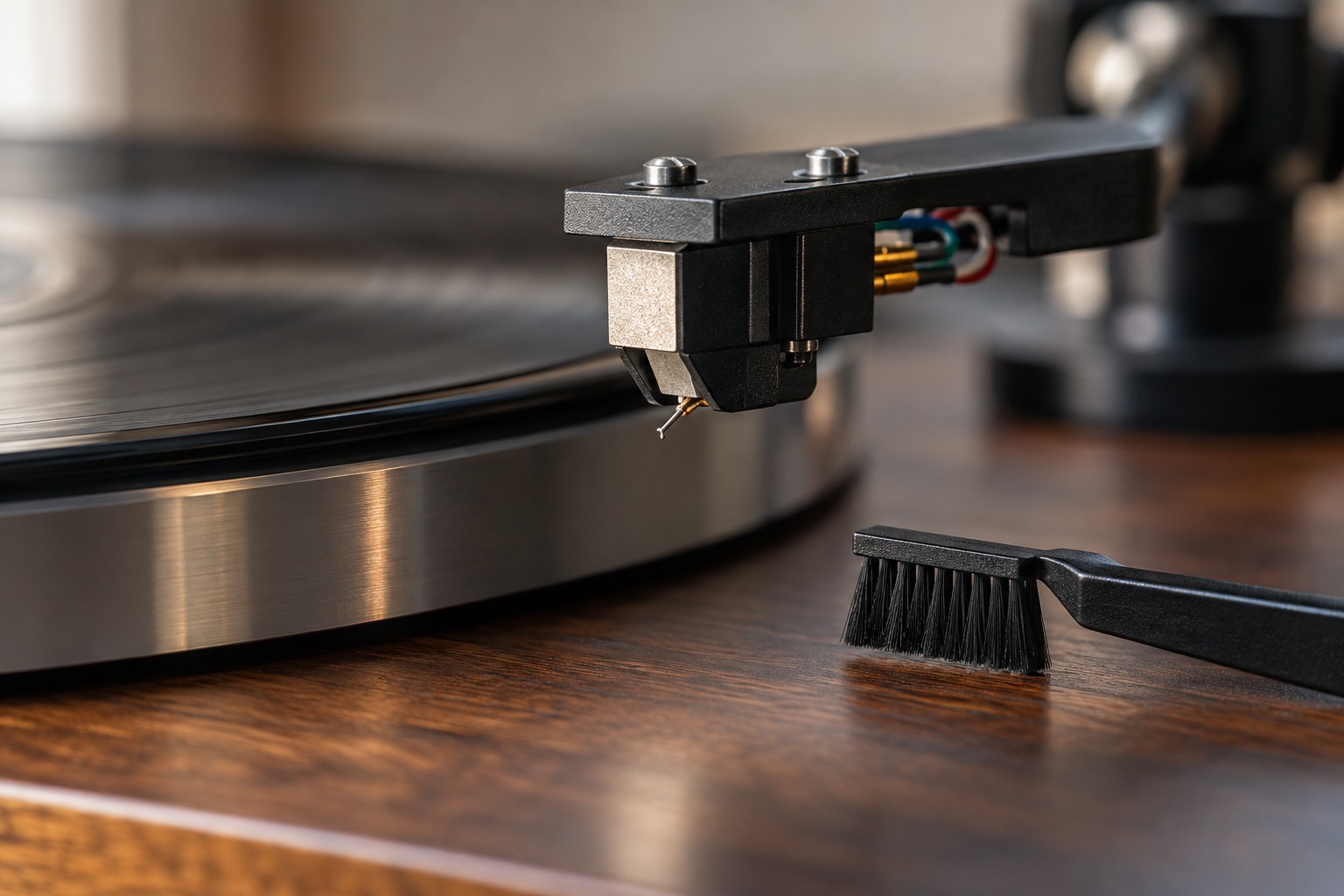
Check whether the manufacturer describes routine user cleaning and which tools are approved. A product advertised as a universal stylus cleaner should not override the cartridge's own restrictions. The brush, liquid or contact method needs to be suitable for the assembly, including its suspension and attachment materials.
Follow the permitted direction and method
Ortofon's guidance recommends a suitable fine brush and a movement along the cantilever toward the stylus tip, and advises against solvents for its stated care routine. Read the illustrated instructions for the cartridge rather than relying on a vague description such as brushing back and forth. Direction matters around a delicate cantilever.
Prepare the turntable as its instructions require, with playback stopped and the tonearm controlled in the prescribed way. Work in good light where the brush and stylus can be seen clearly. Keep sleeves, loose cables and other objects away from the arm so that an accidental movement does not interrupt the task.
Do not use a fingernail, a sharp object or an ordinary household brush to remove a stubborn deposit. If the approved routine does not clear it, ask the cartridge maker or a service provider for advice. Continuing with more force can turn a cleaning question into a damaged component.
Inspect without promising a diagnosis
A visible dust accumulation can be noted, but an ordinary glance is not a reliable measure of stylus wear. Do not assume that a clean appearance proves the tip is undamaged or that a change in sound necessarily means dirt. Tracking setup, record condition and other parts of the system can require separate attention.
If the stylus is bent, displaced or otherwise visibly damaged, stop playback and obtain the appropriate replacement or service guidance. A new cleaning accessory will not correct a mechanical fault. Keep any protective guard used according to the maker's instructions and avoid fitting it by pressing near the cantilever.
Store the approved cleaning tool where its bristles remain clean and undistorted. Check the record-care routine as well, because a repeatedly dirty stylus may be part of a broader handling or storage problem. Maintain the cartridge with the least intervention its instructions require, and keep model-specific advice available for the next inspection.