Decide how long it will remain there
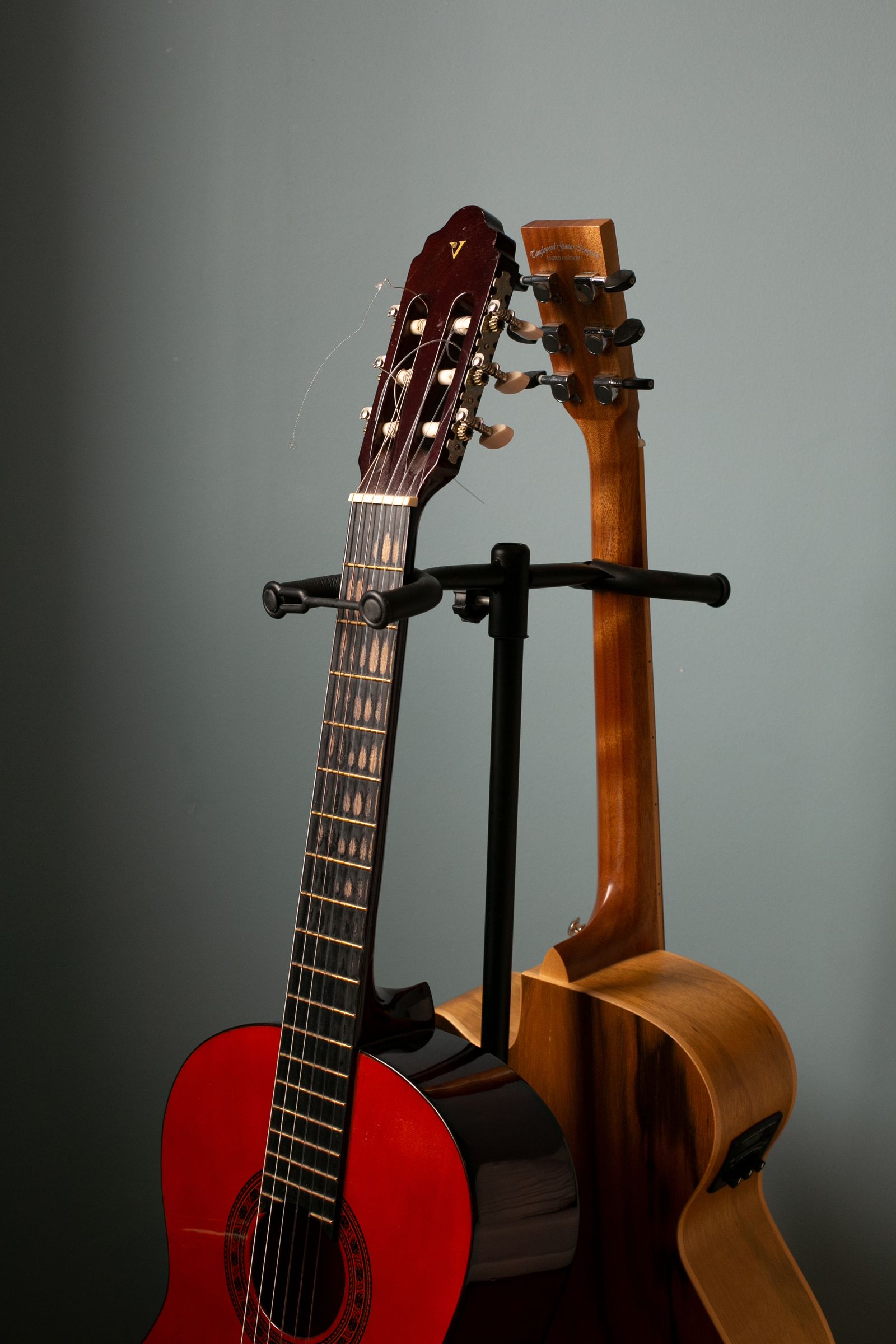
A pause during practice and storage between occasional sessions are different situations. For a short break, use a support intended for the instrument instead of leaning it against an amplifier or chair. For longer storage, compare a suitable case with the maker's guidance for the room conditions and the guitar's construction.
Consider the people and movement around the instrument. A stand behind an opening door or beside a walkway can be disturbed even when it feels stable in an empty room. Choose a position where the guitar can be lifted out without catching a strap, cable or nearby furniture.
Check the contact points
Confirm that the stand or hanger is compatible with the guitar's shape and finish. Padding that feels soft is not by itself proof of finish compatibility. Read the accessory maker's limitations and the guitar manufacturer's storage advice, particularly for an unusual or refinished instrument.
Examine where the body, neck or headstock actually rests. The support should work as designed without relying on a protruding control, strap button or cable plug to keep the guitar in place. If a retaining mechanism is provided, use it according to its instructions and check that it closes without pressing against a string or tuner.
A wall hanger also depends on the wall and its fixing system. Use a mounting arrangement approved for the surface and load, and obtain suitable installation help where needed. Do not assume that a bracket supplied in a box is appropriate for every wall construction or that a decorative board is a structural mounting point.
Make putting it away a short routine
Disconnect a detachable lead as directed and keep it from pulling on the guitar during storage. Check that the strap cannot catch a stand or case closure. If using a case, place loose picks, tools and other small items in the intended accessory compartment rather than leaving them against the body.
Follow the instrument's guidance for environmental conditions and avoid obvious sources of rapid change, such as a heater directly beside the case. Keep any monitoring equipment positioned so that it does not mark the finish or obstruct closing. A case should close normally without extra pressure over the bridge or headstock.
Before the next session, inspect the support and guitar briefly. A shifted stand, damaged pad or trapped cable is easier to correct before lifting the instrument. The best arrangement makes safe placement almost automatic while leaving enough space to retrieve the guitar without improvising a path through the room.