Start with the instrument's recommended range
Read the humidity guidance for the actual guitar and its construction. Taylor, for example, recommends monitoring the storage environment with a digital hygrometer that records minimum and maximum values and gives 45–55 percent relative humidity as its recommended range. Use the maker's guidance for your instrument instead of treating a number from a different product as universal.
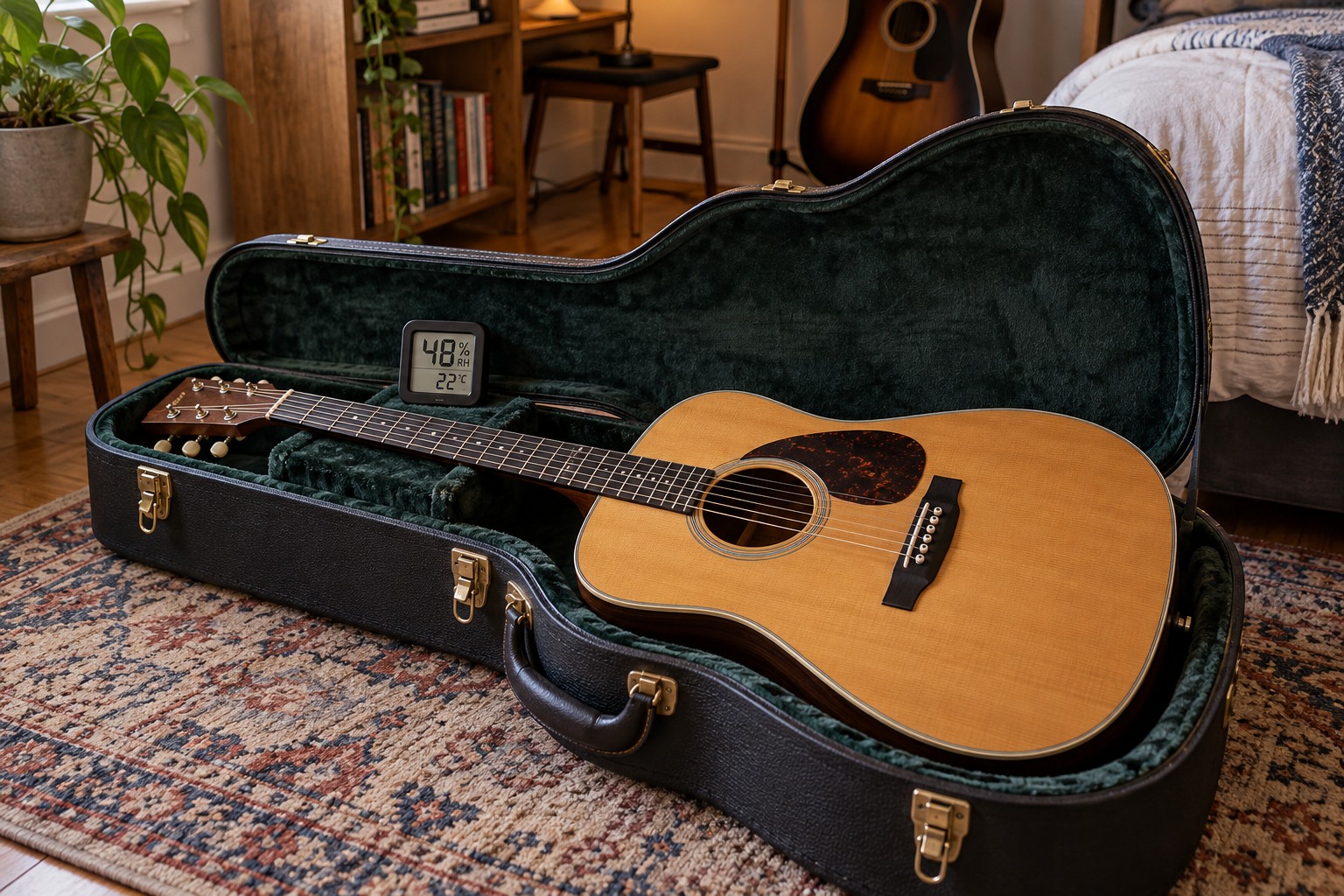
Identify where the guitar spends most of its time. A room reading beside a window may not represent the inside of a case or another part of the room. Decide what you need to measure and choose a device that fits that location without touching or pressing against the instrument. Keep any sensor mounting method compatible with the case and finish.
Choose a display and history you will actually use
A large display is convenient in a room, while a compact sensor may fit a case compartment more comfortably. Consider whether you can read it without repeatedly moving the guitar or leaving the case open for a long time. A display that is awkward to reach is more likely to be ignored than one integrated into the storage routine.
Minimum and maximum readings can reveal changes between your usual checks, but learn when the device resets them. Record the reset time when comparing days. If a sensor offers an app or cloud account, inspect its battery needs, connectivity and data requirements rather than assuming the extra features are necessary for a single instrument.
Check the stated accuracy, operating conditions and any manufacturer procedure for verification or adjustment. Two inexpensive meters disagreeing does not tell you automatically which is correct. Avoid making a large change to the storage arrangement on the basis of one unexplained reading; first check placement, battery condition and the meter's instructions.
Respond to a pattern, not an accessory advertisement
Keep a short record of readings and relevant changes such as heating being used or the guitar moving rooms. You do not need an elaborate spreadsheet: a dated note can show whether the environment repeatedly leaves the recommended range. Compare like with like, using the same measurement location and allowing the sensor to settle as directed.
If adjustment is needed, choose a method approved for the instrument and storage setup. A case product and a room appliance address different spaces. Follow instructions for placement, maintenance and checking, and never improvise a wet item against the guitar. Too much moisture is not an improvement over too little.
Keep monitoring after the first adjustment
A new product in the case does not eliminate the need to observe conditions. Check the readings again after changes and at the intervals suggested by the relevant manufacturers. Include the sensor battery and any consumable replacement in the same routine so the system does not silently stop providing useful information.
If the guitar develops changes in playability, visible deformation or cracking, seek instrument-specific service advice. A hygrometer helps describe the environment; it cannot diagnose every structural problem or confirm that damage has been repaired. Keep the measurement history available so a repairer can understand the conditions without relying on a single recollection.