Identify each finished area
Look up the guitar's model and finish specifications, including the neck and body where they differ. Gloss, satin and unfinished-looking surfaces should not automatically receive the same treatment. An instrument can also have repairs or refinishing that change what is appropriate, so ask the seller or repairer if its history is uncertain.
Taylor's care advice distinguishes gloss and satin surfaces and cautions against wax or thick polish on satin areas because it can leave an uneven appearance. Treat that as a reason to check the precise finish and approved product, not as a universal recipe for every acoustic or electric guitar.
The fingerboard is another separate surface. Do not spread body polish over it simply because the cloth is already in your hand. Its material and finish need their own instructions, and a product described as conditioning wood is not automatically suitable for a finished fingerboard or the rest of the instrument.
Inspect the cloth before the guitar
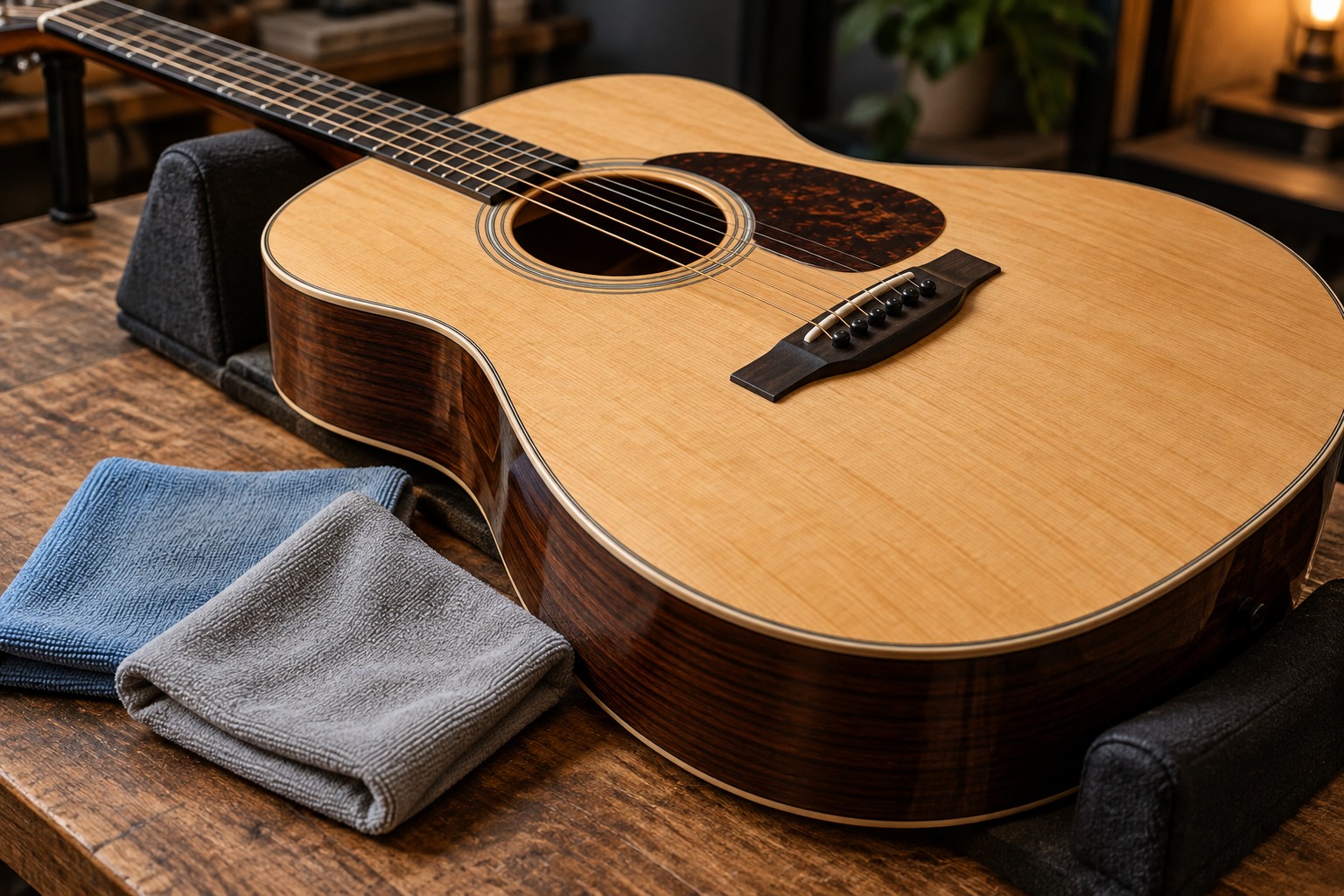
Choose a soft cloth without rough seams or exposed labels where they will contact the finish. Inspect it for grit before each use. A small particle carried from a workbench can undermine the point of selecting a gentle fabric, so store guitar cloths in a clean pouch rather than loose with tools and string offcuts.
Keep separate cloths for different approved products and for dry finishing. Labeling the pouch is easier than trying to remember which nearly identical cloth has polish on it. Wash reusable cloths according to their instructions and ensure they are fully dry and free of unsuitable residue before returning them to the care kit.
Make routine care modest
Support the guitar securely on a suitable surface before cleaning. Remove grit using the method recommended for the instrument, and follow the product instructions for applying any approved cleaner. Do not spray near electronics or openings merely because the body finish can tolerate that product elsewhere.
After playing, the maker's simple wipe-down routine may be all that is needed. Repeated polishing without a specific reason is not a substitute for keeping the instrument and cloth clean. Check contact areas such as the forearm position and neck gently, without turning a small mark into a concentrated rubbing session.
If a mark remains, photograph it and ask the manufacturer or a repair professional for guidance. Cracks, lifting finish and an unknown sticky deposit are different problems from ordinary surface dust. Keep the care kit limited to products whose role is understood, so an unfamiliar bottle is not used simply because it came in a larger accessory bundle.