Check the route from the source
Find out how the existing system will feed the subwoofer. A dedicated subwoofer output, a pair of line outputs, and speaker-level connections are different arrangements. The subwoofer must explicitly support the chosen connection. Do not connect an amplifier’s speaker output to a line input, and do not assume that an unused socket on a speaker is an output.
Determine whether the system provides bass management or merely sends a full-range signal to the main speakers while adding the subwoofer. That distinction affects how the crossover controls are used. Read the manuals for both devices and make a simple connection drawing before ordering cables. If the route is unclear, ask the manufacturer using the exact model names.
Placement is part of the adjustment
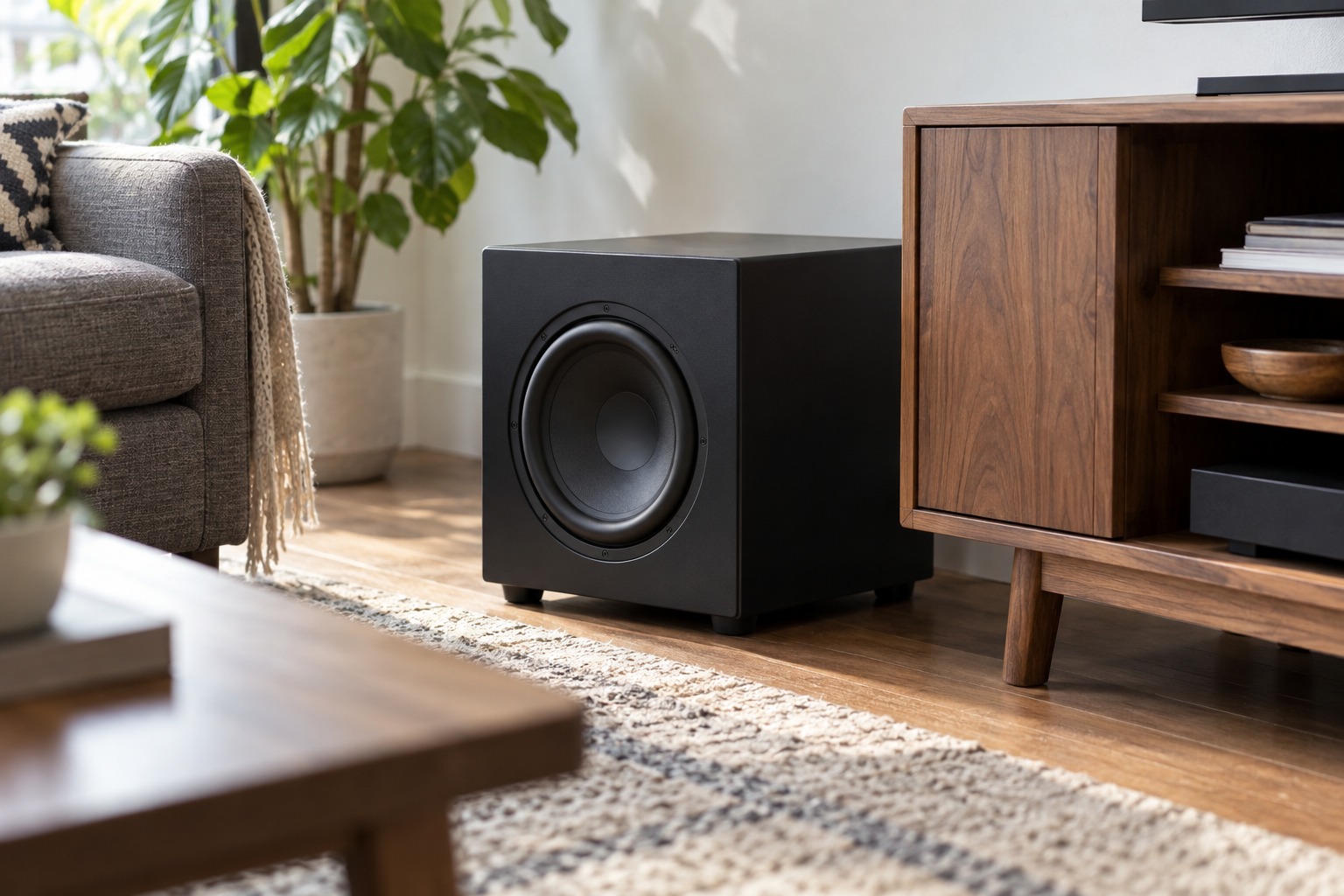
Genelec notes that wall or corner placement can increase subwoofer output, but the position producing the most output is not necessarily the one with the smoothest response. In a small room, compare several feasible locations rather than assuming the empty corner is best. Keep required ventilation and cable clearance, and avoid a location where feet or a chair will hit the cabinet.
Use familiar music with several bass notes and listen from the normal seat. Then move to a nearby seat and notice whether the balance changes dramatically. A placement that works at one point may behave differently across the room. If only one listening position matters, optimize for that position while accepting that the room is not uniform.
Adjust without turning the subwoofer into the whole mix
Begin with the manufacturer’s suggested crossover and phase procedure and a conservative level. Change one control at a time. The goal for ordinary music listening is a coherent transition to the main speakers, not a bass effect that draws attention on every track. Use more than one recording and include music with little deep bass so you can hear whether the system is adding an unnecessary emphasis.
If the system includes measurement or calibration tools, follow their instructions and keep the microphone position consistent. Do not copy another room’s settings from a forum. Room dimensions, placement, main speakers, and listening distance all affect the result. Save the final settings or photograph the controls so accidental movement can be corrected.
Consider the rest of the household
Check the result at the levels and times you expect to use. A setting that suits an afternoon session may be unsuitable late at night in a shared building. Keep a convenient way to reduce or disable the subwoofer if needed. Adding one should make the listening system more useful, not create a setup that can only be enjoyed under rare conditions.