Use a familiar stick as the reference
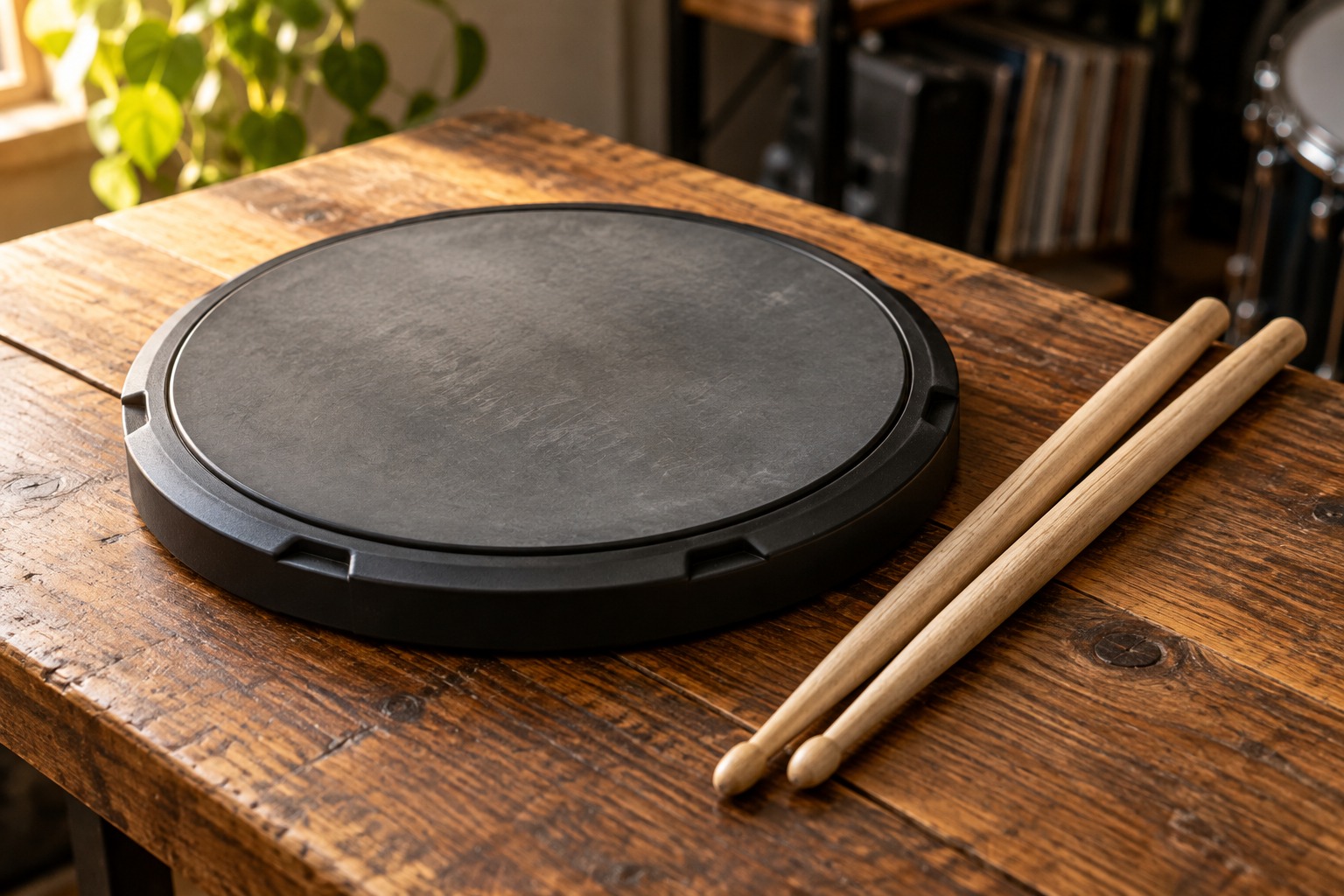
If you already play a kit, begin with the stick you normally use. If you are starting lessons, ask the teacher for a suitable general-purpose pair. Size labels provide a rough description, but dimensions and balance vary between makers. Check length, diameter and tip shape rather than assuming every pair with the same label feels identical.
Inspect both sticks for obvious warping, splits or rough areas. Roll them on a suitable flat surface if the maker's design allows a meaningful check, and compare their feel in each hand. A damaged stick is a poor basis for evaluating a new pad because it can produce inconsistent contact and feel.
Compare rebound at ordinary force
Place the pad on a stable support at an appropriate height and try slow alternating strokes. Notice how readily the stick returns and whether the surface encourages you to grip harder. A lively pad can be useful for some exercises, while a less bouncy surface may feel closer to a different playing task. Neither should be sold to yourself as a complete replacement for every drum surface.
Avoid striking much harder simply to make a pad feel more responsive. The comparison should use the technique you are learning. A teacher can help distinguish a surface preference from a movement that needs adjustment. Short trials with breaks make that distinction easier than continuing until your hands feel tired.
Hear the room as well as the pad
Listen to the impact sound and any vibration passed into the table or stand. A pad described as quiet can still be noticeable in a shared room, especially on a resonant desk. Check the base material and use a support appropriate for the product. Do not balance it on a stack of cushions that moves under the sticks.
Consider diameter in relation to the exercise and storage. A larger target may be comfortable for learning, while a smaller pad is easier to carry. Check whether a threaded mount is included or requires a compatible stand; a screw fitting should not be assumed universal.
Keep the surface clean according to its instructions and protect it from loose tools in a bag. If the pad has multiple playing surfaces, understand their intended uses rather than treating the reverse as an arbitrary substitute. The useful purchase is a pad you can set up consistently and practice on without fighting its support or noise.